New Publication: Environmental estrogen affects nociception and behavior in Euprymna scolopes

3do hatchling of Euprymna scolopes exposed to ethynl estradiol. ©CrookLab

3do hatchling of Euprymna scolopes exposed to ethynl estradiol. ©CrookLab

Congratulations to Crook Lab MS graduate Stephanie Bazarini, who published her work titled “Environmental estrogen exposure disrupts sensory processing and nociceptive plasticity in the cephalopod, Euprymna scolopes”, this week in the Journal of Experimental Biology. This paper is based on Stephanie’s Masters thesis, in which she combined her interests in the role of estrogens in pain plasticity, and in comparative neurobiology of pain.

Her work demonstrates that both constant, low exposure , and brief, high-level exposure to synthetic estrogen in seawater can have detrimental effects on injury-induced neural and behavioral plasticity. Cephalopods like Euprymna scolopes are exceptionally vulnerable to predation, to injury and to coastal pollutants, and her study shows that these factors combine in ways that are likely to disrupt adaptive behaviors. Her work also suggests that estrogen’s role in modulating pain neural circuits extends beyond vertebrates, a highly novel and important finding for comparative and evolutionary neuroscience.

Congratulations Stephanie!!

Do oysters feel pain? PI Robyn Crook discusses on French radio

Oysters are unlikely to feel pain

Oysters are unlikely to feel pain

The French-language Science program “Science et Vie” fielded a listener question that asked “Do oysters feel pain?” Dr. Crook gave her opinion on this question by discussing the nervous system of oysters, the difference between nociceptive reflexes and the emotional response of pain, and ultimately the presenter reassured the listener that pain experience in oysters is extremely unlikely. Text and audio of the segment (in French) can be found here

Congratulations Meghan!

Meghan Holst

Meghan Holst

Crook Lab MS student Meghan Holst has been admitted to the PhD program at UC Davis, where she will work in the Durand Lab to continue her ongoing studies of seven-gill shark populations in the SF Bay. Meghan will continue her position at the Aquarium of the Bay during her PhD studies, and hopes to combine her public outreach and conservation work there with her new focus on high-level marine ecosystem research. Congratulations Meghan!!!

Alumni Update - Ryan Howard catches a giant squid!

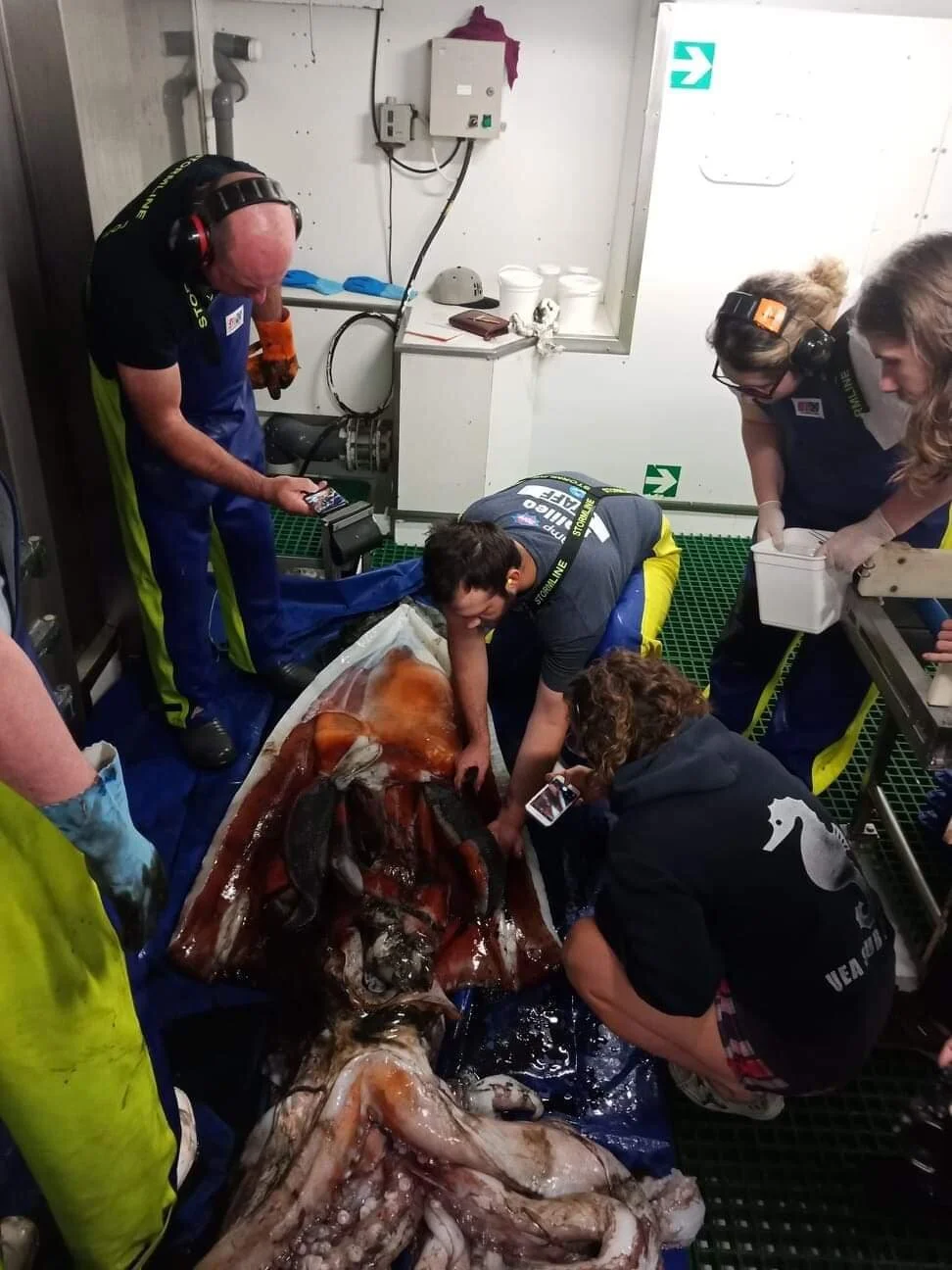
Ryan Howard directs a dissection of a giant squid, Architeuthis dux, on board the RV Tangaroa

Ryan Howard directs a dissection of a giant squid, Architeuthis dux, on board the RV Tangaroa

Crook Lab alumnus Ryan Howard (MS Marine Biology, 2019) is currently a PhD candidate at the Aukland University of Technology, where he is studying adaptations in the visual system of deep-sea squid. Ryan has recently returned from a research expedition to Chatham Rise (off New Zealand’s coast), where the vessel caught a giant squid, Architeuthis dux, for his research. Ryan sent us some photos of the dissection process to obtain samples for multiple research projects, and the catch made headlines across New Zealand.

AUT News NZ Herald Stuff.co.nz NZ news1

It’s so exciting to see the amazing work our former students are doing as they move on with their careers!

Alumni Update - Congratulations Rob!

Rob Veline

Rob Veline

Crook Lab alumnus Robert Veline (BS Physiology, 2016) has been admitted to the PhD program in Neuroscience at the City University of New York. Rob worked in the Crook Lab as an undergraduate research fellow, where he led a study of learning and memory in Euprymna scolopes. A paper describing operant conditioning in Euprymna was published in the Biological Bulletin in 2017. Since graduating from SFSU, Rob has been working in the auditory neuroscience lab of Professor Michael Brainerd at UCSF. We wish him well in his studies in New York City!

Dr. Crook on KCBS radio on the ethics of octopus farming

Dr. Robyn Crook on KCBS radio

Dr. Robyn Crook on KCBS radio

This morning Dr. Robyn Crook was interviewed on KCBS radio during a segment on the emerging controversy around efforts to develop farming methods for octopus. There is considerable interest in developing new technologies for supplying reliable sources of food to the world’s growing population, and octopuses are appealing because they grow quickly and are high in protein. However, several recent articles have focused on the ethical implications of creating an industry exploiting intelligent, potentially conscious species such as octopus. In addition to discussing ethical concerns and methods of humane killing, as well as the ecological implications of in-shore intensive aquaculture of cephalopods.

Congratulations Ryan!!

Ryan Howard profile pic

Ryan Howard profile pic

Congratulations to Ryan Howard, who graduated from the Crook Lab in May 2019, on his admission to the PhD program in Biology at the Aukland University of Technology in New Zealand!!

Ryan will be working with well-known cephalopod biologist, Dr. Kat Bolstad, who runs the ALCES lab at AUT. He will be conducting research on the retinal anatomy of deep-sea oegopsid squid. His surveys of retinal structure across a range of species from diverse habitats will provide novel comparative information on the visual capabilities of cephalopods inhabiting disparate light conditions. The survey will include (1) species that remain in coastal and/or shallow (brightly lit) waters throughout their lives, whose eyes should therefore be able to accommodate the high light

intensities of day-time as well as night-time conditions; (2) species that spend their entire lives at great depth and are therefore presumably never exposed to daylight; (3) species that are able to migrate vertically between photic and aphotic waters over a short period of time, e.g., on a daily basis; and (4) species that inhabit shallow waters during early life stages and descend into the deep sea with maturity.

We wish Ryan all the best with his new adventures in New Zealand!!

New Publication: Early-Life Injury in Squid

Neuroscience of injury in Euprymna scolopes on Phil Trans cover

Neuroscience of injury in Euprymna scolopes on Phil Trans cover

Congratulations to MS graduate Ryan Howard, and BS (Physiology) Graduates Lauren Lopes, Christina Lardie and Paul Perez, for publishing their work titled “Early life injury produces lifelong neural hyperexcitability, cognitive deficit and altered defensive behavior in the squid, Euprymna scolopes” in Philosophical Transactions of the Royal Society B. It is part of a special issue on the evolution of mechanisms relation to pain. This paper has a long story in our lab; Lauren and Christina first worked on this project in 2016, when we set out to look at the time course of behavioral changes after injury in juvenile squid. When we found nothing much of note in the 2-3 weeks after injury, we let the squid grow to adults for breeding. We also used some of them for an

electrophysiological study on an unrelated question once they were adults, and Lauren and Paul discovered the life-long sensitization of primary afferents in the squid that had received injury as small juveniles. But, after an unexpected power failure led to the loss of our breeding colony of Euprymna in 2017, the project was put on hold for almost 2 years. Ryan picked it up again in early 2019 and conducted the behavioral assays on a new cohort of adults, showing cognitive effects, and finally we were able to make this wonderful paper come together. Well done to all authors for their perseverance and hard work!!

Congratulations Hanna!!

Hanna Butler Struben

Hanna Butler Struben

Crook Lab Masters student, Hanna Butler-Struben, was accepted into the PhD program in Animal Behavior at UC Davis. Hanna graduated from SFSU with her Masters degree in 2018. She will be working in the field of applied animal welfare. Using her knowledge in pain physiology, she will study how injury can affect behavior and cognition in dairy cattle. Having an applied focus to her project, the ultimate goal is to create better welfare practices that can be used by the dairy industry. Congratulations Hanna!!

Can Plants Learn? SFSU biology faculty mentioned in Discover Magazine

Pea_tendrils.jpg

“Plant cognition” is a hot topic. Whether plants can learn about and remember their prior experiences is the subject of several recent research studies proposing that classical conditioning occurs in pea and mimosa plants. Professors Andy Zink and Robyn Crook were mentioned in a recent article in Discover Magazine outlining the controversy and problems replicating these astounding results.

Congratulations Stephanie!!

Stephanie Bazarini celebrating with champagne!

Stephanie Bazarini celebrating with champagne!

Congratulations to Stephanie Bazarini, who successfully defended her thesis titled “Effects of ethinyl estradiol on injury-induced plasticity in Euprymna scolopes” on May 22nd. Stephanie’s work showed that exposure to both low and high doses of this environmental pollutant interferes with neural plasticity and alters behavioral maturation in squid; the first time that an effect on sensory physiology has been reported in cephalopods exposed to environmental estrogens. Stephanie will spend the summer collecting some additional data on neuroanatomy in her subjects, and will be applying to PhD programs in the Fall. Great work Stephanie!

Dr. Robyn Crook interviewed on NPR

The Crook Lab’s work on the evolution of pain was featured on NPR’s Morning Edition on May 20th. The segment titled “How the Brain Shapes Pain and Links Ouch with Emotion” featured several researchers working in different aspects of pain physiology and a chronic pain patient discussing his experience with managing life-long pain. Read the associated article (with a link to the audio) here

Congratulations Vivien!!

Vivien Enriquez celebrating with champagne after her successful defense

Vivien Enriquez celebrating with champagne after her successful defense

Congratulations to Vivien Enriquez, who successfully defended her thesis titled “Influence of Vibrio fischeri colonization on Hawaiian bobtail squid (Euprymna scolopes) behavior and survival” on May 17th. In her project, Vivien demonstrated that ambient light levels have differential effects on squid survival in the absence of their symbiont, V. fischeri, and that hunting behavior matures differently in aposymbiotic squid reared in different levels of ambient light. Vivian’s work will be submitted for publication in the current months, and Vivien is off to UCLA to start her PhD in the Fall. Great work Vivien!!

Congratulations Ryan!!

Ryan Howard celebrates after his successful MS thesis defense.

Ryan Howard celebrates after his successful MS thesis defense.

Congratulations to Ryan Howard, who successfully defended his thesis titled “The influence of nociceptive sensitization and self-referential visual cues from superficial injuries on camouflage behaviors of Indo-Pacific Octopuses” on May 14th. In his study, Ryan demonstrated the first evidence for visual self-referencing of skin camouflage match in cephalopods, and showed that nociceptive cues are necessary to drive this hyper-vigilant inspection behavior. Ryan will be publishing his work in the coming months (look out for his paper on the Publications page!) and applying to PhD programs in the Fall. Great work Ryan!!

Stephanie Bazarini represents SFSU at CSU-wide research competition

Stephanie Bazarini

Stephanie Bazarini

After winning her local division in the SFSU research competition, this weekend Stephanie traveled to CSU Fullerton to compete in the annual CSU-wide research presentation contest. This contest features graduate researchers from all CSU campuses, who are judged based on the quality of their written report of the their research and a 15-minute presentation. Stephanie’s work on the effects of environmental estrogens on injury-induced plasticity received excellent reviews from attendees and judges alike. Congratulations Stephanie!!

CONGRATULATIONS VIVIEN!!

Vivien Enriquez

Vivien Enriquez

Masters student Vivien Enriquez (Class of 2019) was accepted to the Biology PhD Program at UCLA, and was awarded the Eugene V. Cota Robles Fellowship for PhD study. Vivien will defend her MS thesis in the Spring and then head off to UCLA to continue her great work on microbiomes. Congratulations Vivien!!

SFSU Pain Group PIs speak at Royal Society

Theo Murphy meeting at Chichley Hall, hosted by the Royal Society

Theo Murphy meeting at Chichley Hall, hosted by the Royal Society

SFSU Physiology faculty members Dr. Robyn Crook and Dr. Megumi Fuse presented their lab groups’ work on comparative models of nociceptive sensitization at the Royal Society at Chichley Hall, Milton Keynes, UK. This conference focused on evolution of pain-like behavior in a wide range of species, and brought together researchers working on humans, rodents and a range of invertebrate models. Look out for a special issue of Philosophical Transactions of the Royal Society of London B. coming out in the next few months, which will contain contributed articles from conference attendees, including papers from both the Crook and Fuse labs.

Vivien and Stephanie present their work at SICB

Vivien Enrique and Stephanie Bazarini

Vivien Enrique and Stephanie Bazarini

This week Masters students Vivien Enriquez and Stephanie Bazarini attended the annual SICB meeting, this year in Tampa, Florida. Both students gave oral presentations on their Masters theses. Vivian’s presentation was titled “Effects ofVibrio fischeri colonization on cognition, foraging behavior, and survival in the Hawaiian bobtail squid”, and Stephanie’s presentation was titled “Effects of Ethinyl Estradiol on Injury-Induced Plasticity in Euprymna scolopes”. Congratulations to Vivien and Stephanie for two excellent presentations!