
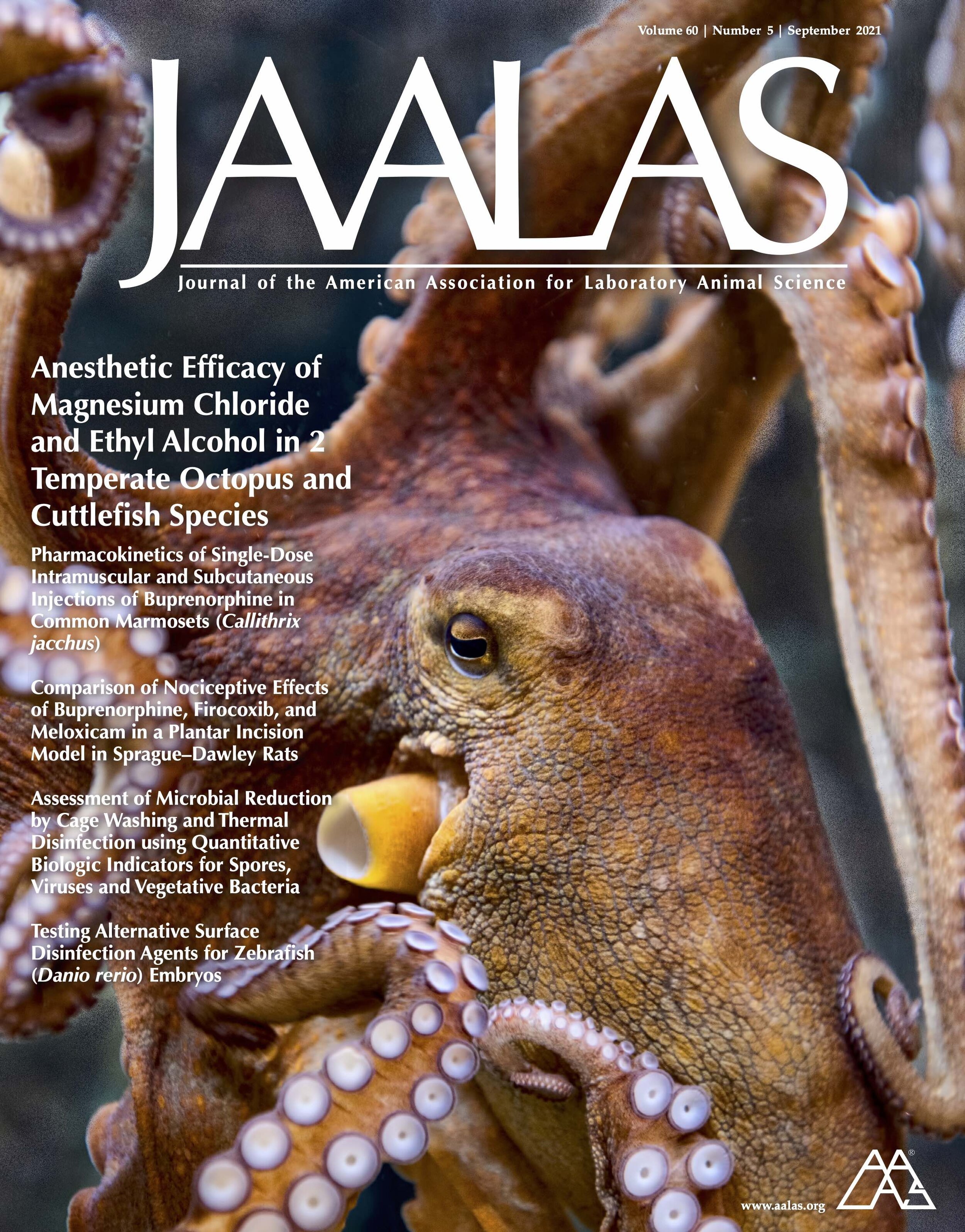
Our recently published paper “Anesthetic efficacy of magnesium chloride and ethanol in temperate octopus and cuttlefish species” is featured on this month’s cover of JAALAS magazine. This is the flagship journal of the American Association for Laboratory Animal Sciences, and their decision to feature an invertebrate - which is currently not a regulated species under US animal welfare law - on their cover demonstrates the growing awareness of welfare and refinement in research using cephalopods as model organisms. Congratulations to our fantastic team of veterinary medicine collaborators who led the study at the MBL!
Re-starting after COVID...

A section through a sucker of O. rubescens, showing degeneration in the cells of the epithelium and muscle. ©CrookLab
In the past few weeks, with the Fall 21 semester getting started and our university campus slowly re-awakening after more than a year of being completely closed, the Crook Lab has also begun to resume research activities! We’re welcoming new MS, undergraduate and postbac researchers (see the People page to learn more about them), we’re repairing and cycling our animal housing systems ready for new animals, and we’re resuming work on projects that have been on hold for almost two years. Last week we began collecting new data to complement our ongoing study of neural degeneration in senescent cephalopods, including a new species for the study, Octopus rubescens. The first images we’re collecting from animals in Meghan Holst’s study look exciting and it’s great to see some new raw data coming out of the lab! Stay tuned for more updates as we get up to full speed again!
Robyn Crook quoted in the Atlantic

Crook Lab PI Robyn Crook commented in The Atlantic on a new study showing that cuttlefish in the early stages of senescence can form and retain complex memories. In this new work (in which the Crook Lab was not involved), common cuttlefish (Sepia officinalis) were able to retain complex learned associations between food type, feeding location and time-of-day even once they had begun to decline due to senescence. This interesting behavioral work may lead to new understanding of mechanisms that underly terminal decline in brain function in diverse species, including humans and other mammals.
New publication: Anesthesia in temperate cephalopods
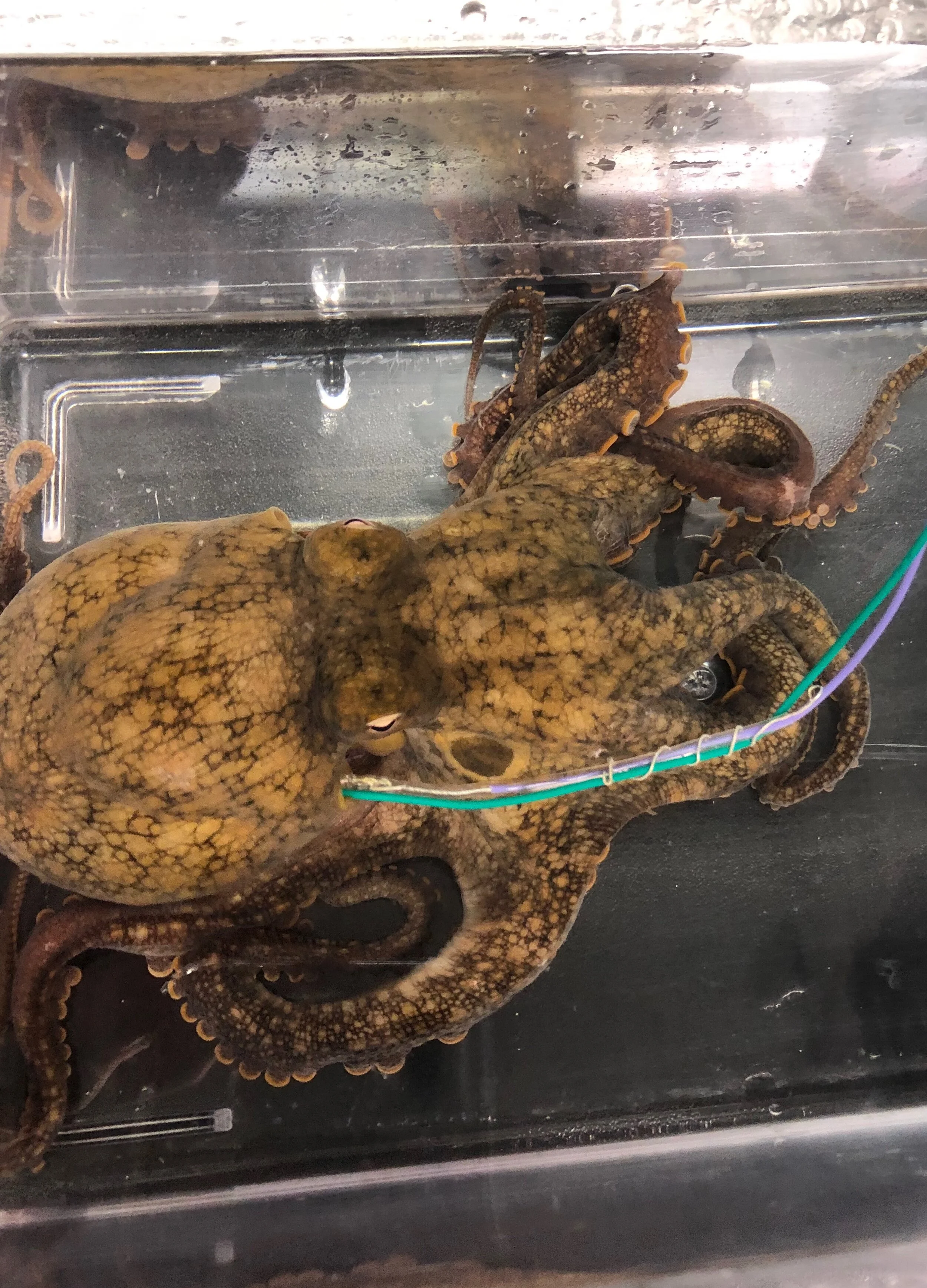
Adult Octopus bimaculoides with recording electrode collecting information non-invasively from the pallial nerve, which carries information between the mantle and brain. Image by Lisa Abbo, MBL
The lab’s latest paper on anesthesia of cephalopods, “Anesthetic Efficacy of Magnesium Chloride and Ethyl Alcohol in Temperate Octopus and Cuttlefish Species” has just been published in JAALAS, the Journal of the American Association of Laboratory Animal Science. This paper was a joint effort between the Crook Lab and the Marine Biological Laboratory, one of the major cephalopod culturing facilities in the United States. Lisa Abbo, who lead the study and is the first author on the paper, is the staff veterinarian at the MBL. In this paper we use the same methods that we have used previously to study anesthesia in tropical species, and we show that in temperate species, the effects are similar. For the first time we also assess differences in anesthesia in young and old animals, showing that senescence complicates and extends anesthesia durations, and also increases adverse effects.
In future work we plan to study analgesia in both temperate and tropical cephalopod species, to continue to support efforts to ensure humane treatment of cephalopods in research laboratories worldwide.
Crook Lab work on octopus pain features in The Guardian
A recent article in the Guardian by UK-based philosopher Johnathon Birch discusses a new bill introduced to the the UK parliament that aims to declare vertebrate animals sentient, but also allows for the case-by-case inclusion of invertebrates into the law. The article describes our recent publication on affective pain experience on octopus, and suggests that sentience in invertebrates may be a widespread phenomenon.
Improving welfare of cephalopods in research, captive settings and fisheries is a major goal and broader impact of our lab’s work, and we look forward to seeing further discussion of the mounting evidence that cephalopods deserve regulatory protection both inside and outside of research labs.
The Crook Lab at the American Malacological Society annual meeting
AMS annual meeting
This week Dr. Crook presented some highlights of the Crook Lab’s ongoing work on nociception and pain in cephalopods in the symposium on Advances in Molluscan Behavior. The symposium produced some great discussions on regulations, new techniques and progress in molluscan research across the USA.
NSF grant awarded to the lab to study neural mechanism of injury-induced behavior

PI Robyn Crook awarded NSF CAREER grant
Our lab’s work has been funded by the NSF for the next five years, to continue our work on elucidating neural mechanisms of plasticity that underlie injury-induced behaviors in cephalopods. This grant includes funding for studies looking at fitness effects of injury-induced behavior in contexts that have not previously been studied, such as in mating and reproductive success. Other experiments are focused on mapping and characterizing nociceptive sensory neurons in the peripheral ganglia and central brains of cephalopods, and continued work supporting welfare-based refinements to experimental procedures using cephalopods. This grant mechanism (NSF CAREER) also includes support for educational work and outreach that our lab already does regularly, so this will allow us to grow these efforts to support neuroscience training for students in the Department of Biology, and continue our work engaging pre-K children in STEM.
Crook Lab research featured in Scientific American Magazine

Scientific American Magazine 4.23.21
Our recent paper on pain experience in octopus features in a new article out today in Scientific Amercian Magazine. The article describes a scene in the recent documentary “My Octopus Teacher” where the octopus survives a predation attempt but loses an arm in the process; this type of injury is exceptionally common in wild cephalopods. Our lab’s research on physiological responses to injury in cephalopods supports the idea that cephalopods have a similar experience of pain as mammals after tissue injury, and that similar welfare protections for cephalopods in fisheries and research are warranted. Read the article here.
Megan's paper on giant Pacific octopus welfare in the news!

A Giant Pacific Octopus interacts with a caretaker
While Meghan Holst was completing her MS degree in our lab she was also working on a long-running project developing an objective welfare assessment tool for giant Pacific octopuses held in public aquaria, with the goal of improving decision-making around end-of-life care and euthanasia. Her work was published late last year in the Journal of Applied Animal Welfare Science, and recently has been featured on the Oregon State University news page (link to the news story and interview with the authors is here). Meghan graduated from the MS program here in 2020 and is currently working toward her PhD at UC Davis, and also continues her work at the Aquarium of the Bay in San Francisco.
It’s great to see the continued success of the Crook Lab’s outstanding student alumni!
New publication: Pain experience in octopus
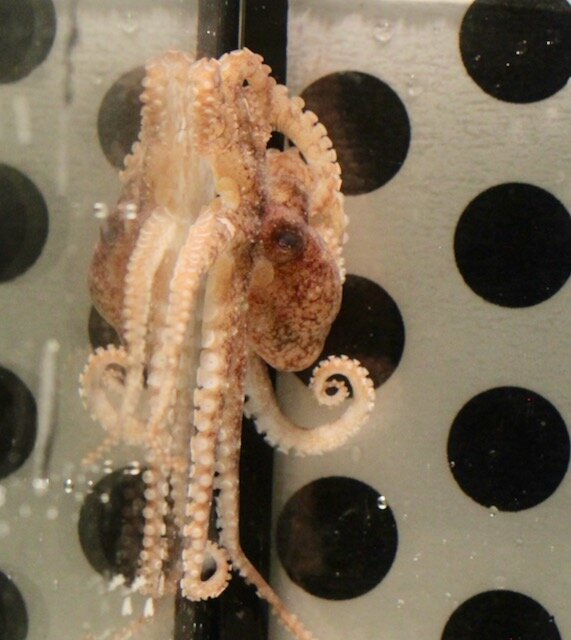
Octopus bocki explores in an Condition Place Preference chamber, where visual cues link an experience with a particular context. ©CrookLab
The newest work from our lab has just been published in iScience. In this study, we show that octopuses demonstrate behaviors that strongly indicate that they are able to experience the affective, or emotional, component of pain. These finds are a significant advance for cephalopod welfare - it is the first clear demonstration of this ability in cephalopods even though there has been ongoing conjecture about such abilities for a many years. This study also provides a framework through which welfare-promoting interventions, like analgesics, can be assessed objectively. More about our work on pain and welfare can be found here. The paper is available open access from iScience, and a news report on the work is available from Academic Times.
Congratulations Meghan!

Meghan Holst defends her thesis by Zoom
Congratulations to Crook Lab MS student Meghan Holst, who successfully defended her thesis titled “Behavioral and neural indicators of welfare in senescent giant Pacific octopus, Enteroctopus dofleini”. Meghan’s project involved a multi-site behavioral study of GPOs in zoos and aquariums across the USA, along with analysis of histological samples from euthanized GPOs. Her data indicate significant new concerns for animal welfare at the early stages of senescence, and raise many new questions about how and when the nervous system declines to the point that these animals are no longer experiencing acceptable quality of life in captive settings.
Her wonderfully successful defense was a great way to cap off a year that has been exceptionally challenging both for research labs like ours and for public zoos and aquariums across the country where her research subjects were housed. Meghan has already started her PhD work at UC Davis and continues to work at Aquarium of the Bay, so we look forward to many more great things from her as she continues her research career.
Do zombies feel pain? An interview with Dr. Zed

Do zombies feel pain? While it’s not a question the lab has previously considered, it’s a hot topic in the world of zombie enthusiasts! What is it about 'zombification’ that makes zombies seemingly insensible to pain, and what would the ethics of experimenting on zombies be? Dr. Crook spoke to Dr. Zed (aka Joe Alcock, an emergency medicine physician at Arizona State University), about pain research, how infectious agents can inactivate pain to gain an advantage over the host, and how an evolutionary perspective on pain can shed new light on pain treatments for humans (and zombies, presumably). A fun outreach event to a very different audience! A replay of the segment on Channel Zed can be found here on YouTube.
New pre-print posted; pain in octopus

An octopus explores the Conditioned Place Preference box. ©CrookLab
Whether cephalopods (and other invertebrate animals) can experience the emotional, affective component of pain (i.e., to know that a noxious sensation is unpleasant or distressing, rather than simply responding via unconscious, behavioral reflex), has always been an unresolved question. The newest work from our lab uses a widely validated assay for studying the affective component of pain in laboratory rodents, to show that octopuses behave the same way. The most parsimonious explanation for the behavior of the octopuses in this experiment is that they are capable of the negative affective state that characterizes pain experience in mammals. This is the first conclusive evidence for this capacity in any invertebrate.
Knowing the answer to this question is more than just a scientific curiosity; it is essential to advancing moves to treat cephalopods more humanely in whichever context they encounter humans - in research labs, but also in zoos, aquariums and in fisheries.
We recognize that research work on pain in animals like cephalopods, with their highly complex brains, is controversial. However, the lack of clarity on the question of whether invertebrate animals can suffer as a result of noxious sensory input continues to hamper efforts to improve their welfare. Our goal with this study was to move the question of invertebrate pain beyond reasonable doubt, so that efforts to better regulate their humane use can proceed with a strong evidentiary foundation that until now, has been lacking.
Evidence for vertebrate-like pain experience in invertebrates has been inconsistent and focused mostly on crustaceans and insects. Some studies supported the hypothesis that the emotional component of pain was present in invertebrates and some did not; there have been very few studies that took validated assays for measuring pain in vertebrate animals and applied them to invertebrates, leaving room for the interpretation that the experimental evidence was insufficient proof of an equivalent emotional state underlying equivalent behavior. In this paper we show that not only can vertebrate specific protocols for testing pain’s presence and absence be adapted to cephalopods, they can reveal the same evidence for internal state.
Octopuses in Pre-K education outreach

CrookLab octopuses visit a local daycare center

Little hands and gentle touches!
Lots of fun today as some of the lab’s retired octopuses visited a local daycare center, to provide an early childhood education experience for the children and staff. Children were able to observe the octopuses up close while the octopuses moved about in shallow tubs that provided shelters and hiding spaces. Whenever we do outreach activities like this we work hard to ensure that the animals’ welfare needs are balanced against the goals of an up-close-and-personal interaction for the children. This visit was a great success!
New Publication: Environmental estrogen affects nociception and behavior in Euprymna scolopes

3do hatchling of Euprymna scolopes exposed to ethynl estradiol. ©CrookLab
Congratulations to Crook Lab MS graduate Stephanie Bazarini, who published her work titled “Environmental estrogen exposure disrupts sensory processing and nociceptive plasticity in the cephalopod, Euprymna scolopes”, this week in the Journal of Experimental Biology. This paper is based on Stephanie’s Masters thesis, in which she combined her interests in the role of estrogens in pain plasticity, and in comparative neurobiology of pain.
Her work demonstrates that both constant, low exposure , and brief, high-level exposure to synthetic estrogen in seawater can have detrimental effects on injury-induced neural and behavioral plasticity. Cephalopods like Euprymna scolopes are exceptionally vulnerable to predation, to injury and to coastal pollutants, and her study shows that these factors combine in ways that are likely to disrupt adaptive behaviors. Her work also suggests that estrogen’s role in modulating pain neural circuits extends beyond vertebrates, a highly novel and important finding for comparative and evolutionary neuroscience.
Congratulations Stephanie!!
Do oysters feel pain? PI Robyn Crook discusses on French radio

Oysters are unlikely to feel pain
The French-language Science program “Science et Vie” fielded a listener question that asked “Do oysters feel pain?” Dr. Crook gave her opinion on this question by discussing the nervous system of oysters, the difference between nociceptive reflexes and the emotional response of pain, and ultimately the presenter reassured the listener that pain experience in oysters is extremely unlikely. Text and audio of the segment (in French) can be found here
Congratulations Meghan!

Meghan Holst
Crook Lab MS student Meghan Holst has been admitted to the PhD program at UC Davis, where she will work in the Durand Lab to continue her ongoing studies of seven-gill shark populations in the SF Bay. Meghan will continue her position at the Aquarium of the Bay during her PhD studies, and hopes to combine her public outreach and conservation work there with her new focus on high-level marine ecosystem research. Congratulations Meghan!!!
Alumni Update - Ryan Howard catches a giant squid!
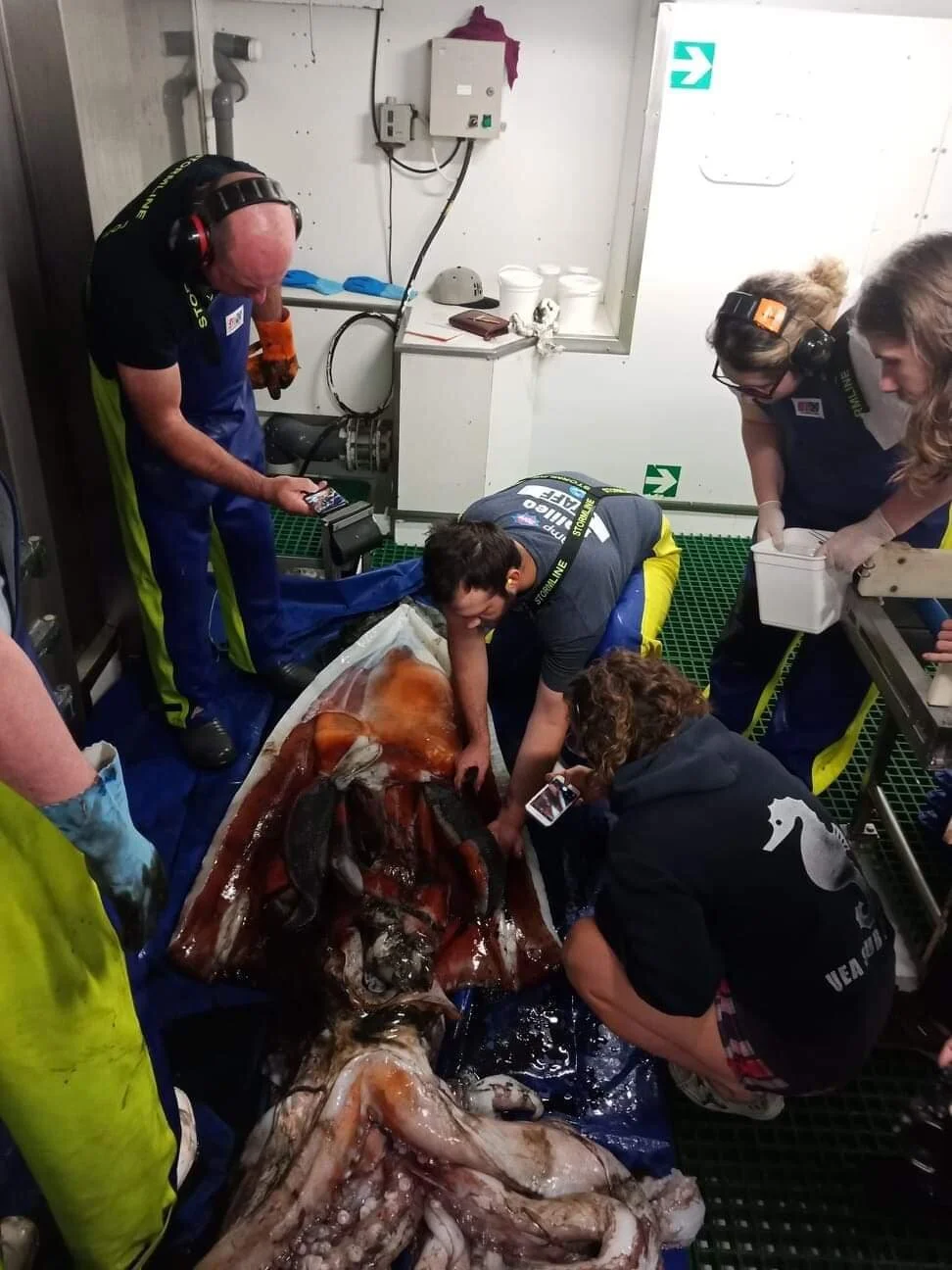
Ryan Howard directs a dissection of a giant squid, Architeuthis dux, on board the RV Tangaroa
Crook Lab alumnus Ryan Howard (MS Marine Biology, 2019) is currently a PhD candidate at the Aukland University of Technology, where he is studying adaptations in the visual system of deep-sea squid. Ryan has recently returned from a research expedition to Chatham Rise (off New Zealand’s coast), where the vessel caught a giant squid, Architeuthis dux, for his research. Ryan sent us some photos of the dissection process to obtain samples for multiple research projects, and the catch made headlines across New Zealand.
AUT News NZ Herald Stuff.co.nz NZ news1
It’s so exciting to see the amazing work our former students are doing as they move on with their careers!
Alumni Update - Congratulations Rob!

Rob Veline
Crook Lab alumnus Robert Veline (BS Physiology, 2016) has been admitted to the PhD program in Neuroscience at the City University of New York. Rob worked in the Crook Lab as an undergraduate research fellow, where he led a study of learning and memory in Euprymna scolopes. A paper describing operant conditioning in Euprymna was published in the Biological Bulletin in 2017. Since graduating from SFSU, Rob has been working in the auditory neuroscience lab of Professor Michael Brainerd at UCSF. We wish him well in his studies in New York City!
Dr. Crook on KCBS radio on the ethics of octopus farming

Dr. Robyn Crook on KCBS radio
This morning Dr. Robyn Crook was interviewed on KCBS radio during a segment on the emerging controversy around efforts to develop farming methods for octopus. There is considerable interest in developing new technologies for supplying reliable sources of food to the world’s growing population, and octopuses are appealing because they grow quickly and are high in protein. However, several recent articles have focused on the ethical implications of creating an industry exploiting intelligent, potentially conscious species such as octopus. In addition to discussing ethical concerns and methods of humane killing, as well as the ecological implications of in-shore intensive aquaculture of cephalopods.